Is it easy to review or assess the software from a legal, financial or security perspective?
LASR Quality Model
Quality requirements are essential in serious software reviews. Therefore, the most important quality attributes and assotiated objectives form the benchmark by which the software is measured.
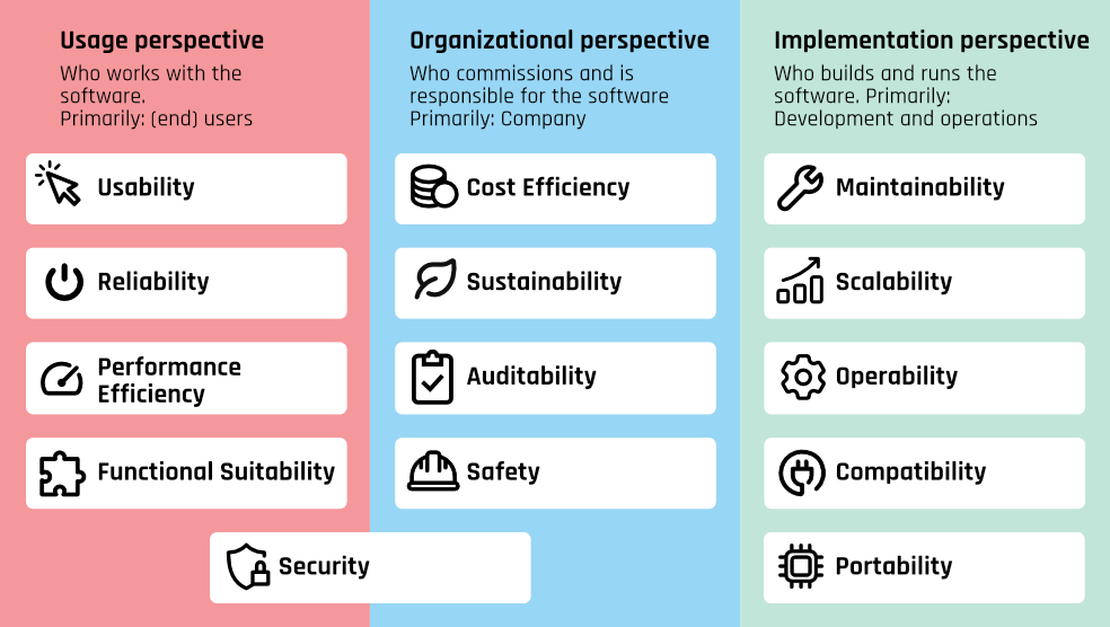
LASR defines 14 quality attributes and 3 primary stakeholder perspectives. The 9 standard attributes of ISO 25010 are included with minor modification.
Overview
Stakeholder Perpectives
Different stakeholders take different perspectives when evaluating software. The attributes in LASR are therefore assigned to three viewpoints.
Usage perspective:
Held by those who work with the software. These are primarily (end) users. Their focus is on how well the software supports their tasks and workflows.
Organizational perspective:
Held by those who commission and are responsible for the software. These are primarily companies or organizations, and their management respectively.
Implementation perspective:
Held by those who build and/or run the software. These are primarily people from development and operations.
Click on a quality attribute to jump directly to its description.
All Quality Attributes
The quality attributes follow in alphabetical order, each with descriptions and sub characteristics. Under “Keywords:” selected solution approaches, associated concepts, and topics are listed. These make no claim to completeness. If you find that important terms are missing or consider any of them incorrect or irrelevant, please let us know!

 Auditability
Organizational
Sub Characteristics
Traceability:
Are actions, changes, and decisions recorded in a way that allows reconstructing what happened, when, and how?
Keywords: Audit Logs and Change Tracking, Versioning and History, Correlation IDs, Event Sourcing ...
Verifiability:
Can available information and evidence be used to verify whether the software correctly adheres to defined requirements and rules?
Keywords: Tamper-Proof Logging, Digital Signatures, Checksums, Four-Eyes Principle ...
Attributability:
Is it clearly determinable which person or system performed a specific action or change?
Keywords: Personalized User Accounts, Session/User Assignment in Logs, IAM (Identity and Access Management), MFA (Multi-Factor Authentication) ...

 Compatibility
Implementation
ISO 25010
Is the software compliant with standards? is it easy to exchange information or share environments with other systems?
Sub Characteristics
Co-Existence:
Can the software be operated in a way that it shares a common environment and resources with others, without disrupting or limiting their functionality? And without being limited by them in return?
Keywords: Environment-Agnostic Design, Isolation, Quotas, Tenant Separation ...
Interoperability:
Is the software able to exchange data with other systems and make meaningful use of it in order to work together?
Keywords: Protocols, Standardized Interfaces, Identity Providers, Decoupling, API Design, Data Formats and Schemas ...
Versioning Capability:
Is the software capable of supporting multiple versions in parallel, or of introducing changes without affecting existing consumers?
Keywords: Backward Compatibility, API Versioning, Parallel Operation, Schema and Data Migration, Feature Toggles, Consumer-Driven Contracts ...

 Cost Efficiency
Organizational
Is the operation of the system economically optimized? Is it easy to budget for roll-out, change or scaling?
Sub Characteristics
Austerity:
Does the software only incur infrastructure, operational, and licensing costs that are truly necessary? Does it avoid unnecessary ongoing costs?
Keywords: Open Source, Digital Sovereignty, Shared Resources, Cost Monitoring and Budget Limits, Serverless, Auto-Scaling ...
Ability to Estimate:
Can the expected costs and efforts for implementation, operation, scaling, and maintenance of the software be determined with reasonable effort?
Keywords: Use of Established Technologies and Methods, Change-Efficient Bounded Contexts, No Ripple Effects ...
Cost Transparency:
Are development, operational, and usage costs clearly assignable and traceable to individual components or domains of the software? Can cost drivers be identified?
Keywords: Cost Allocation (Tagging), FinOps, Billing Alarms, Chargeback ...

 Functional Suitability
Usage
ISO 25010
Are calculated results precise enough, are measurements exact, is the functionality appropriate?
Sub Characteristics
Appropriateness:
Does the software support the execution of intended tasks while avoiding unnecessary steps?
Keywords: User Stories, Customer Journeys, Usability Tests ...
Correctness:
Does the software produce technically correct and sufficiently precise results?
Keywords: Acceptance Tests, Test Data Catalogs and Edge Cases, Regression Tests ...
Completeness:
Does the software contain all necessary functions for its intended purpose?
Keywords: Requirements Engineering, Personas, Acceptance Criteria, Definition of Done ...

 Maintainability
Implementation
ISO 25010
Is the software easily modified and extended? Is it well tested and understood? Are parts of it reusable?
Sub Characteristics
Analysability:
Can the software be easily examined, for example to identify parts that need modification, estimate the impact of changes, or find the root cause of errors?
Keywords: Modularization, Information Hiding, Coding Guidelines ...
Modifiability:
Can the software be adapted without introducing new defects or negatively affecting the existing product quality?
Keywords: Cross-cutting Concerns, Dependency Inversion, Test Pyramid, Refactoring, Clean Code, Technical Debt ...
Extensibility:
Can functionality and features be added to the software without extensive changes to the existing system or affecting existing parts?
Keywords: Plugins, Interfaces, Open-Closed Principle ...

 Operability
Implementation
Is the software easily operated and supported? Are production problems easy to find and fix?
Sub Characteristics
Observability:
Is the system state transparent enough to quickly detect, isolate, and analyze production issues?
Keywords: Metrics and Monitoring, Logging, (Distributed) Tracing, Health Checks and Heartbeats, Dashboards, Alerts ...
Updatability:
Can updates, patches, and configuration changes be carried out in a controlled, reproducible manner with minimal disruption to operations?
Keywords: Rolling Updates, Blue-Green Deployment, Canary Releases, Rollbacks, Feature Toggles ...
Response Efficiency:
Can incidents or critical load situations be quickly prioritized and effectively addressed?
Keywords: Incident Management, Runbooks and Playbooks, MTTR (Mean Time to Recover), Failover, Circuit Breaker ...

 Performance Efficiency
Usage
ISO 25010
Does the software perform within given time and throughput parameters? Does it make efficient use of resources?
Sub Characteristics
Time Behaviour:
Does the software achieve the expected response times when executing individual requests?
Keywords: Algorithms and Data Structures, Low-Level Implementation, Database Optimizations, Profiling, Distributed Tracing ...
Resource Utilization:
Does the software perform its functions with appropriate use of CPU, memory, and network resources?
Keywords: Pooling and Reuse, Reduction of I/O Calls, Efficient Data Formats, Caching, Compression ...
Capacity:
Can the software handle the expected number of concurrent requests and data volumes? Does it achieve the required throughput?
Keywords: Horizontal and Vertical Scaling, Load Balancing, Sharding and Partitioning, CQRS ...

 Portability
Implementation
ISO 25010
Is the software easily transferred to different HW/SW environments? Is it easily adapted for different contexts?
Sub Characteristics
Adaptability:
Can the software be transferred and operated in different technical or operational environments (hardware, software) with reasonable effort?
Keywords: Avoiding Vendor Lock-in, Platform Independence, Configuration, Open Standards, Containerization ...
Installability:
Can the software be effortlessly set up, launched, and fully removed from a defined target environment when needed?
Keywords: IaC (Infrastructure as Code), Setup Scripts, Package Managers, Configuration Management ...
Replaceability:
Does the software enable a functionally equivalent substitution of an existing product within the same constraints?
Keywords: API Compatibility, Protocols, Data Formats, Migration Strategy, Incremental vs. Big-Bang ...

 Reliability
Usage
ISO 25010
Is the system available, fault tolerant, and quickly restored after crashes or outages?
Sub Characteristics
Availability:
Is the software operational and accessible for use when needed?
Keywords: Uptime, Downtime, Maintenance Windows, 99.999, MTTF (Mean Time To Failure) ...
Recoverability:
In the event of an interruption or failure, can affected data be restored and the desired system state re-established?
Keywords: Backups, Data Consistency, MTTR (Mean Time To Repair) ...
Fault Tolerance:
Does the software function as intended despite the presence of hardware or software failures?
Keywords: Resilience, Eventual Consistency, Idempotency ...

 Safety
Organizational
ISO 25010
Are people, animals, property or the environment protected from damage by the system?
Sub Characteristics
Operational Safety:
Does the software ensure that no hazardous situations arise during operation, including in the event of user errors or system failures?
Keywords: Fail-Safe and Safe State, Redundancy, Watchdog Monitoring, Emergency Stop, Graceful Degradation ...
Verifiability:
Can the safety requirements for the software be systematically tested and demonstrated?
Keywords: Traceability, Test Coverage, Verification, Configuration and Version Control ...
Regulatory Compliance:
Does the software meet the relevant laws, regulations, standards, and guidelines? Are the required evidence and documentation in place for official recognition or approval?
Keywords: External Requirements, Certifications, Regulatory Authorities, Documentation Obligations, Audits ...

 Scalability
Implementation
Can the software react appropriately to growing or shrinking workloads? Can it adapt its capacity to handle variability?
Sub Characteristics
Flexibility of Deployment:
Can the software be operated in different environments? Or is it tied to a specific infrastructure?
Keywords: Infrastructure Independence, Containers, On Premises, Cloud ...
Elasticity:
Does the software support the appropriate adjustment of its resources in response to changes in load?
Keywords: Load Peaks and Spikes, End-of-Month Processing, Black Friday, Pre-Provisioning, Load Balancing and Auto-Scaling ...
Growth Efficiency:
Do the effort and costs for operations and resources remain appropriate as user numbers or data volumes increase?
Keywords: Horizontal Scaling, Data Archiving, Pay per Use ...

 Security
Usage
Organizational
ISO 25010
Is the system secured against attacks? Are data and functionality protected against unauthorized access?
Sub Characteristics
Confidentiality:
Does the software ensure that data is only accessible to authorized persons or systems? Does it prevent unauthorized access?
Keywords: Authorization, Pseudonymization, Data Classification, Encryption ...
Authenticity:
Can the software reliably verify the identity of users and systems? Is the person actually who they claim to be?
Keywords: Authentication, Identity Provider, MFA (Multi-Factor Authentication), SSO (Single Sign-On) ...
Integrity of Data or State:
Does the software ensure that data and system state are protected against malicious manipulation or unintended modification or deletion?
Keywords: Checksums, Digital Signatures, Logging, Versioning ...

 Sustainability
Organizational
Is the development and operation of the software environmental friendly? Is resource consumption efficient?
Sub Characteristics
Energy Efficiency:
Is the energy consumption of the software proportionate to the performance it delivers?
Keywords: Pre-computation and Caching, Pagination and Compression, Right-Sizing, Idle Prevention ...
Low Emissions:
Can the software be operated with as few greenhouse gas emissions as possible?
Keywords: Ecological Footprint, Data Centers with Renewable Energy, Edge and CDN Usage, Workload Shifting, Shared Infrastructure ...
Longevity:
Can the software be used, adapted, and operated over a long period of time without needing to be replaced?
Keywords: Technology Independence, Backward Compatibility, Loose Coupling, Standards and Open Source ...

 Usability
Usage
ISO 25010
Is it intuitive to use the software? Is it recognizable, easy to learn, attractive? Is it hard to run into problems as a user?
Sub Characteristics
Operability:
Do the features and properties of the software support straightforward use and effective control? Does the software feel good to use?
Keywords: Navigation Structure, Status and System Feedback, Shortcuts, Reasonable Defaults, Auto-Completion, Error Prevention, Escape Routes, Undo and Redo, Gamification ...
Learnability:
Does the software allow new users to become productive within a reasonable amount of time?
Keywords: First Use and Onboarding, Self-Explanatory Interfaces, Recognition, Consistent Terms and Metaphors, Iconography, Help Systems, Wizards and Tutorials ...
Inclusivity:
Does the software enable use by people with varying physical, cognitive, language, or technical prerequisites?
Keywords: Flexible Presentation and Clarity, WCAG (Web Content Accessibility Guidelines), Keyboard Accessibility, Voice Control, ALT Texts, Multilingualism (i18n) ...
LASR Quality Attributes on Cards
The 14 quality attributes are available as a card deck. You use them in Step 2 of the LASR approach during the Top-5 Challenger exercise to identify the quality goals. The cards can be downloaded from the community section: As a PDF for self-printing and as PNG files for digital whiteboards. They are also part of the professionally produced LASR card set, which you can purchase from embarc.
Go to the LASR CommunityOrder the professionally printed card set